Data Transports and Registry
Each Paladin runtime needs to share data privately with other Paladins, based on the identities that are transacting.
These message are frequent and occur as part of the Distributed transaction manager operation to coordinate the assembly and submission of transactions.
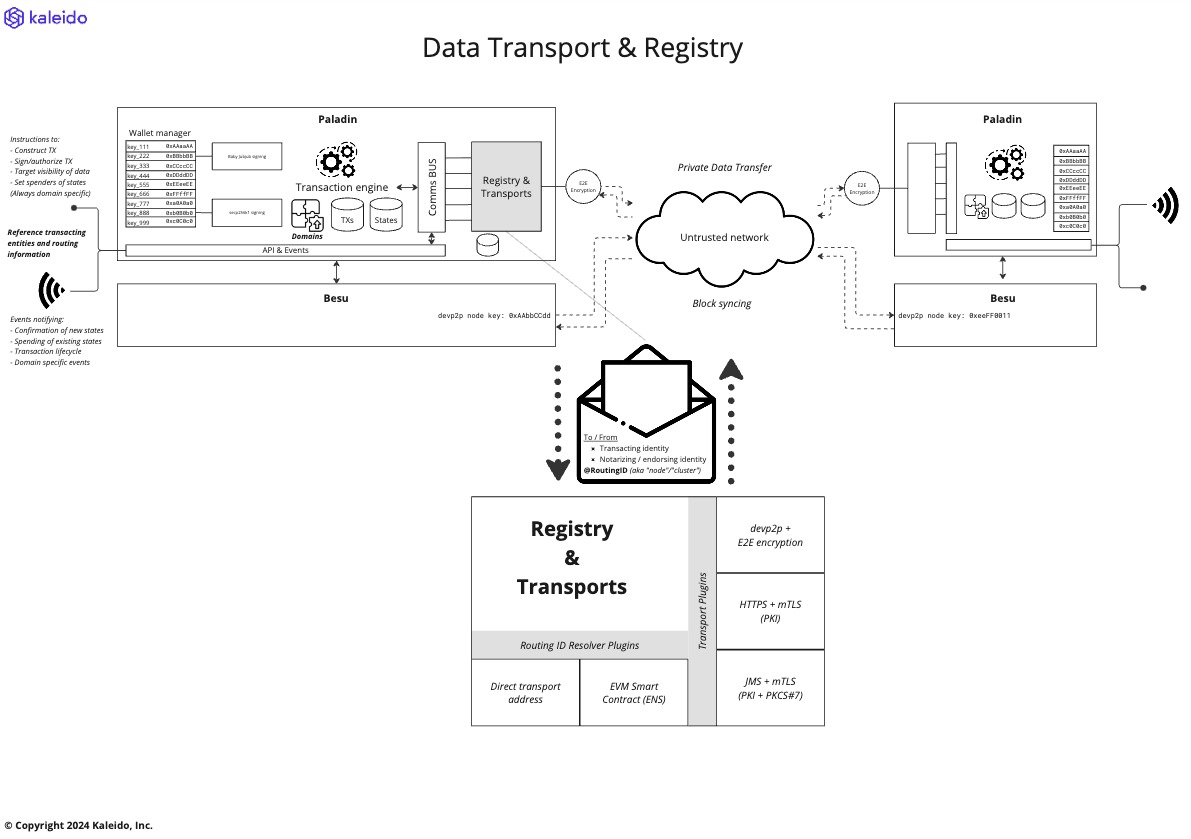
Types of identity
There are two fundamental types of identity involved in Paladin:
Account signing identities
These are able to sign transactions, and hold state/value.
Some are used at the Base EVM Ledger layer to submit transactions, and others are used during ZKP proof generation, or endorsement/notarization flows.
These live for a long time, and are very complex to change
While Paladin supports many underlying technologies to manage the key materials and signing, there are some common attributes:
- A public key identifier
- A type of cryptography (sekp256k1, Baby Jubjub etc.)
- A logical association to an actual identifiable entity, which might or might not be disclosed to others in the network
A single Paladin runtime might manage thousands of these accounts, for different purposes. For example generating a new signing key to submit each transaction to a blockchain for anonymous submission, or managing the keys for many different user accounts that all transact via that Paladin node.
Runtime routing identities
For private data to be able to move securely between Paladin runtimes, a different form of identity is required for the endpoints.
These are used only for data-in-flight. These must be able to change as infrastructure updates, and keys rotate, and they are bound only to runtime infrastructure (not the transacting entities themselves)
They provide transport-specific routing information:
- Transport support information
- IP addresses
- Hostnames
- Topic/queue names
- Transport encryption signing identities (PKI certificates)
A single Paladin runtime might expose multiple external connection transports for other Paladin nodes to connect to. However, those remote nodes must be able to establish securely that they are encrypting and transferring data to the right node.
Routing and delivering private data
When constructing a transaction the signing identities of multiple parties might be involved:
- Initiator of the transaction
- Old owner(s) of the values/states being transferred/spent
- New owner(s) of the values/states being transferred/minted
- Endorsers of the transaction (notary / privacy group)
- Base EVM submission identity
For each of these parties there might be a need to:
- Route data to that party
- Request signing from that party
- Request submission from that party
Some of this information is provided explicitly by the initiator of the transaction, and others are determined by the Paladin node interacting with the privacy preserving smart contract module to orchestrate the transaction.
In each case the Paladin node needs to determine:
- Which account signing identity is involved
- Which runtime route to use to transfer the data
Account & Routing Addresses
Paladin solves this problem by requiring each specification of a target identity to include two parts:
- The
account identifier: points to a signing account - An off-chain address book in each Paladin node allows mapping between arbitrary strings and the underlying address. This is covered in more detail in Key Management
- The
routing identifier: points to a Paladin runtime - This is passed into a
registryplugin to determine the right transport, physical address, and encryption details to use
Registry plugin
The registry plugin is responsible for resolving a routing identifier (a node name string) into the transport details needed to deliver a message — the transport type, connection address, and any TLS/certificate information. It runs as a gRPC subprocess plugin, loaded and managed by Paladin's plugin manager at startup.
Paladin ships two reference registry implementations:
-
EVM registry: monitors an on-chain
IdentityRegistrysmart contract. Nodes register themselves by emittingIdentityRegisteredandPropertySetevents. The plugin streams these events via the block indexer and persists the resulting entries and properties to a local database. When Paladin needs to contact a remote node, it queries the database to find the matching entry and extracts transport details from its properties (e.g. a property namedtransport.grpccarries the gRPC endpoint). Entries can be hierarchical (e.g.org.node1), allowing structured naming schemes. -
Static registry: loads node entries and transport properties from a YAML/JSON configuration file at startup, with no on-chain dependency. Useful for development, testing, or closed networks where node addresses are known in advance.
Both implementations store entries in the same local schema, so the transport lookup logic is identical regardless of which plugin sourced the data. A regex configured per-registry controls which entry properties are treated as transport descriptors, and an optional prefix filter and transport name remapping allow different registries to serve different network segments from the same Paladin node.
Transports
Some fundamental architecture principals are applied to our transports, to allow the rest of the Paladin engine to be agnostic to which transport is used:
- The transport interface is asynchronous event/message transfer
- This does not prevent synchronous protocols like HTTP being used, but the HTTP request must not block waiting for processing. Rather, responses arrive via a later HTTP request in the other direction.
- Resilience is encouraged, but not relied upon by Paladin
- All requests over the transport are idempotent in nature, and will be retried by the Paladin in the case of error
- Encryption must be end-to-end between Paladin runtimes
- Where a hub+spoke transport model exists, such a a central JMS/Kafka message bus, or a multi-hop gossip based peer to peer network, the data must be encrypted before it leaves Paladin, and not decrypted again until received by the final destination Paladin